Modeling Dependency
Modeling site-site dependencies with heterogeneous Hidden Markov Model and bidirectional LSTM
Read the full thesis | GitHub repository
The Problem: Site-Level Summaries Lose Read-Level Structure
Bisulfite sequencing measures methylation on individual DNA fragments. After the reads are aligned, a conventional analysis compresses them into one methylation level for each CpG site: the fraction of covering reads on which that site is methylated. This site-level profile is convenient, but the compression removes information about which methylation states occur together on the same DNA fragment.
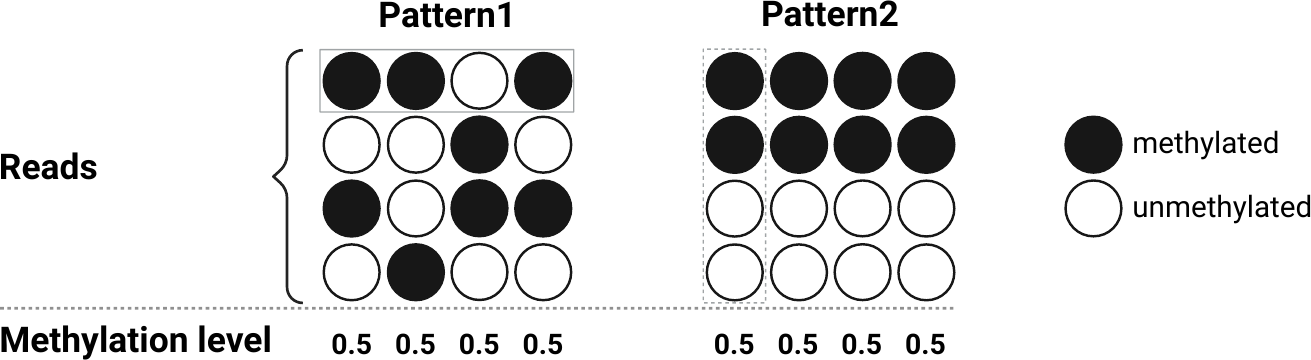
The example above captures the central problem. Every site has a methylation level of 0.5 in both patterns, yet the biological structures are very different. Pattern 1 is mixed, whereas Pattern 2 contains coordinated blocks of methylated and unmethylated states. Once the reads are reduced to four site-level averages, that distinction is lost.
In probability terms, the usual summary retains each marginal probability $P(Y_t=1)$ but discards joint information such as $P(Y_t,Y_{t+1})$. A model can therefore reproduce every site’s methylation level while generating unrealistic read-level patterns.
Why Independent Sampling Is Not Enough
Most bisulfite-sequencing simulators assign the state of each CpG independently using its site-level methylation probability. This independent Bernoulli model preserves the marginals by construction, but it cannot represent co-methylation—the tendency of nearby CpGs on the same read to share a state.
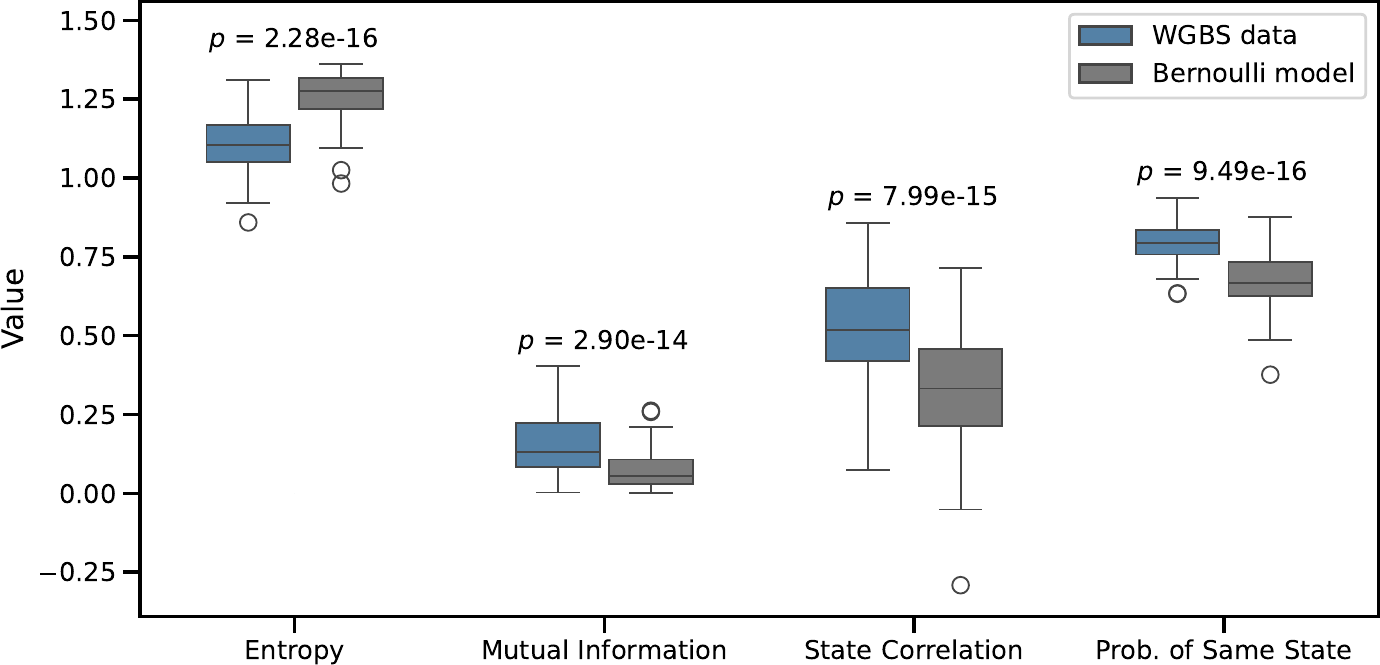
The Bernoulli samples retain the site-level methylation probabilities used to generate them, yet their dependency statistics remain clearly different from the real reads. This shows that the structure in WGBS data is not merely a consequence of neighboring sites having similar marginal levels; there is genuine site-site dependency that an independent model does not capture.
The modeling task is therefore to generate a binary methylation pattern for each read while satisfying two constraints:
- the average generated state at each site should match its observed methylation level
- the generated joint patterns should reproduce how dependency changes with genomic distance and sequence context
Two Complementary Models
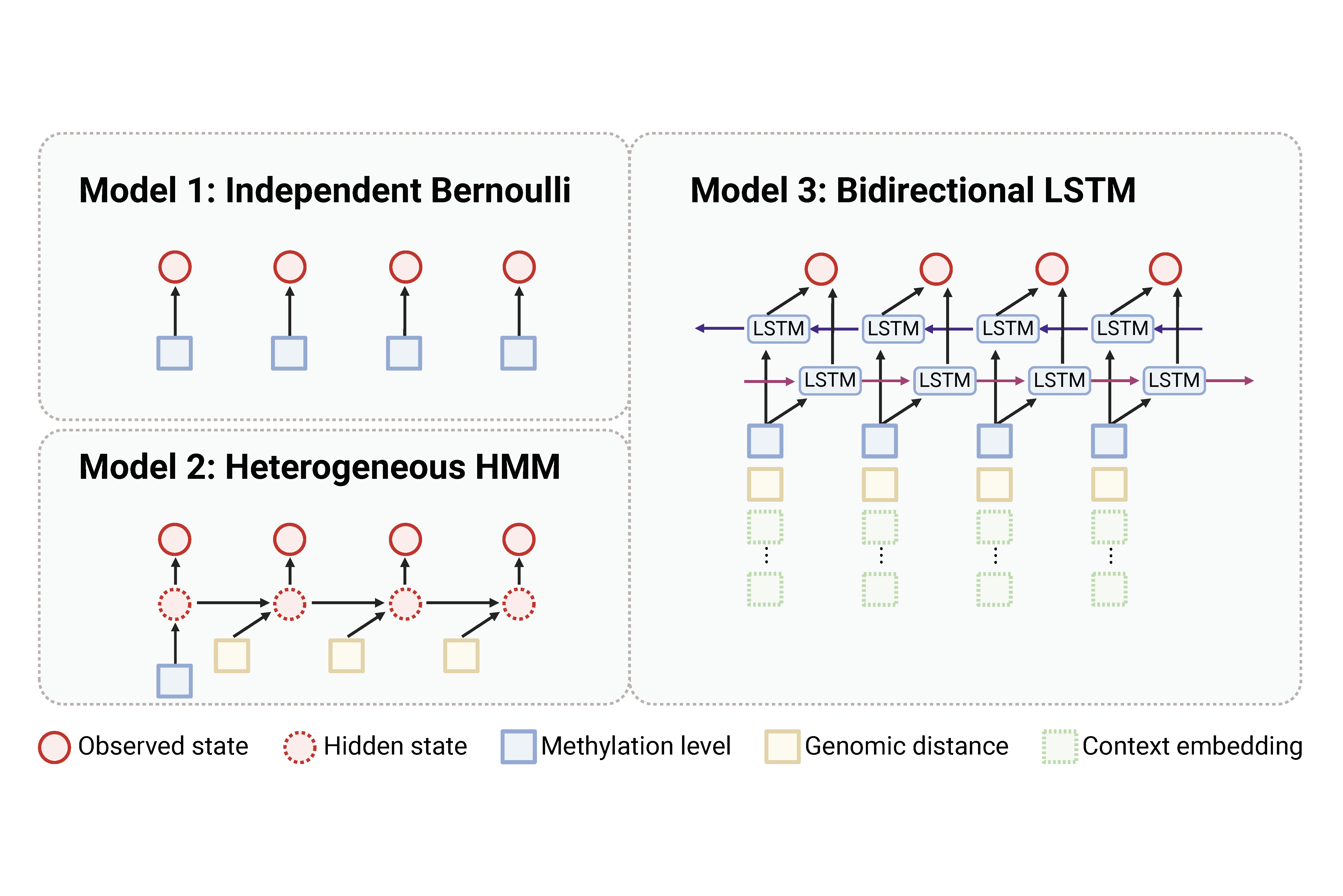
The heterogeneous Hidden Markov Model makes the transition probability between two CpG states a function of their genomic distance. Nearby sites are encouraged to remain in the same state, and that coupling decays as their distance grows. The model also separates the latent biological state from errors introduced during bisulfite conversion and sequencing. Its main advantage is interpretability: the fitted transition function directly describes the distance-dependent relationship.
The bidirectional LSTM learns dependencies from both directions along a read. In addition to methylation levels and genomic distances, it can use local sequence context and flanking bases. This relaxes the HMM’s first-order, distance-only restriction and allows the model to learn more complex patterns.
Results at a Glance
The simulation study evaluates the same two questions under controlled conditions: whether the generated sequences preserve the target marginal methylation profile and reproduce the known distance-dependent site-site relationship.
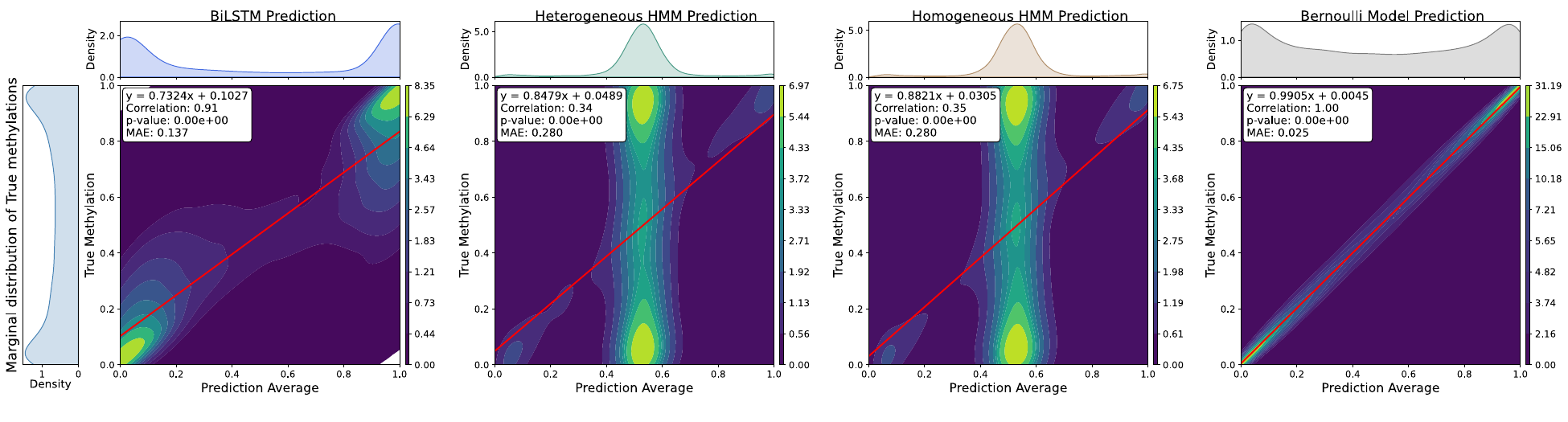
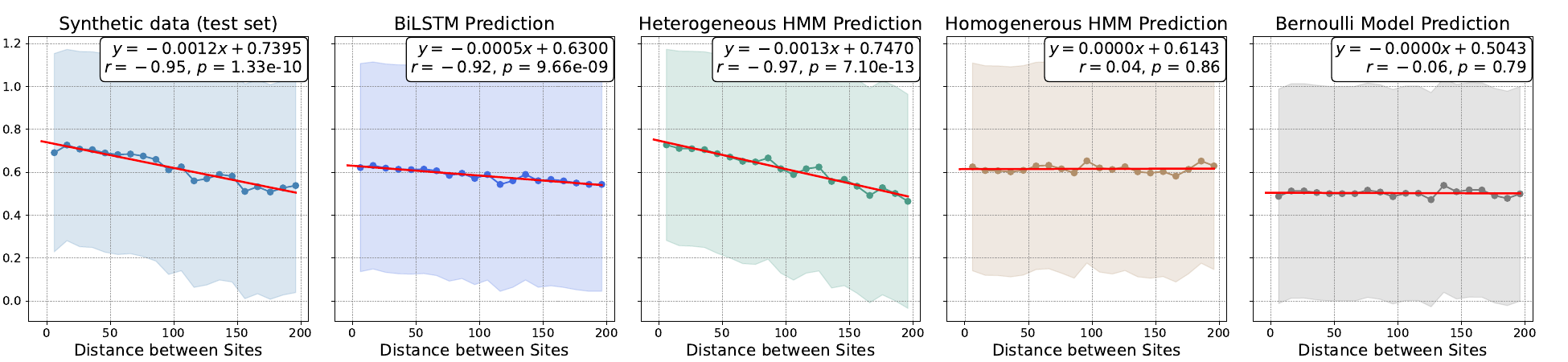
Together, the plots show the central trade-off: matching site-level averages is not the same as preserving their joint structure. The simulation provides a known reference against which both properties can be evaluated directly.
For the model derivations, training procedures, simulation design, numerical comparisons, and complete discussion, see the full thesis on eScholarship.